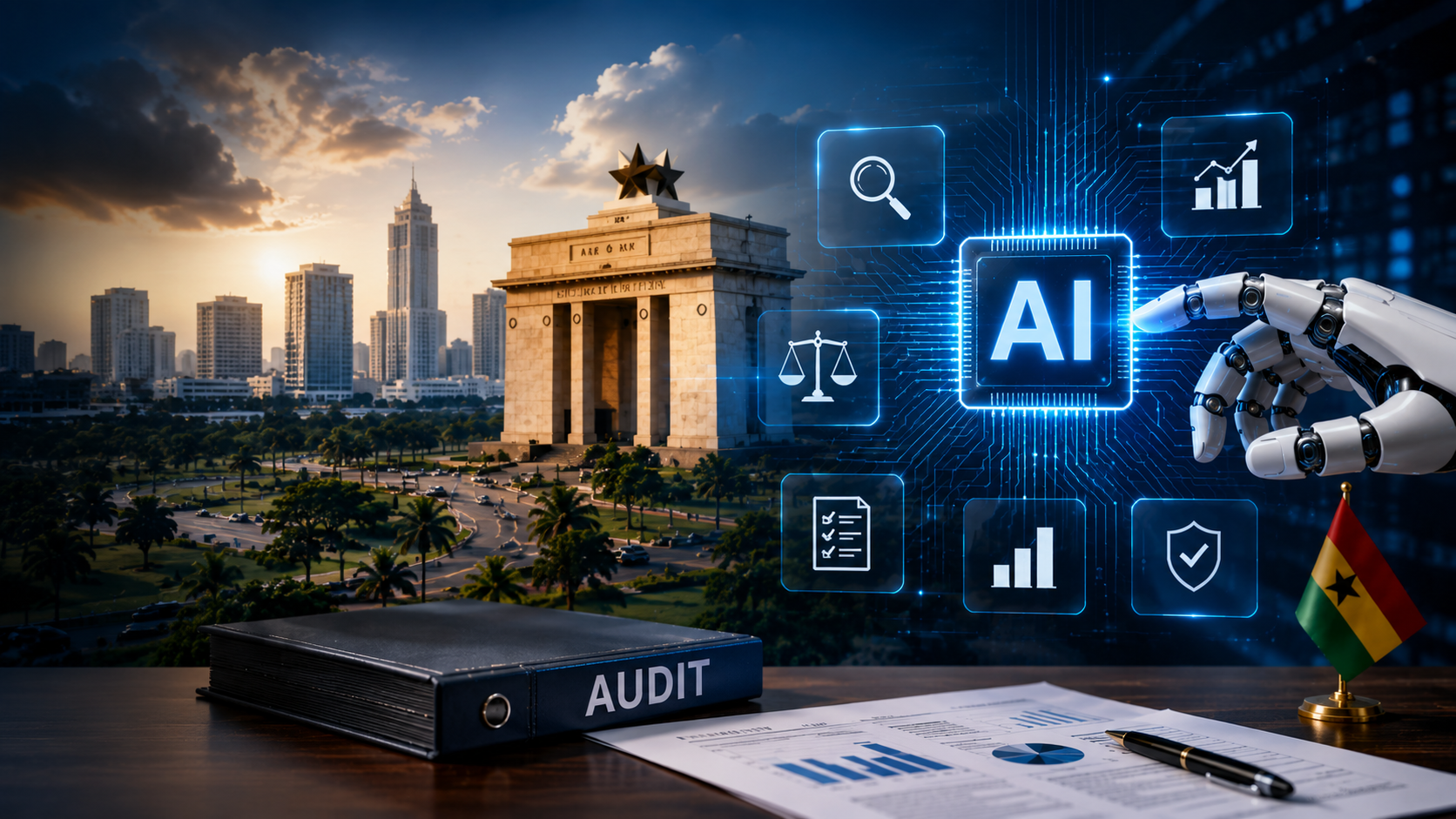
Artificial intelligence is rapidly changing the way businesses generate information, make decisions and manage risk. It is also changing something even more fundamental: how businesses determine whether information can be trusted.
Consider a typical finance function in Ghana. An accountant may use generative AI to analyse a spreadsheet. A Finance Manager may use AI to summarise a lengthy contract. Management may use technology-assisted forecasting, while an ERP system identifies unusual transactions. A CFO may even use AI to prepare the first draft of a Board report.
Individually, these activities may appear relatively simple. Collectively, however, they represent a fundamental change in how financial information is produced, analysed and relied upon. This creates a significant dilemma for audit and assurance.
AI can make audits more comprehensive by allowing auditors to analyse large volumes of transactions, identify unusual patterns and focus attention on higher-risk areas. At the same time, it can generate inaccurate information, create convincing fraudulent documents, introduce cybersecurity risks and make it harder to determine whether information is reliable.
“Is AI becoming the biggest audit risk — or could it become the biggest audit advantage? The answer may well be both.”
AI Has Entered the Finance Function
For many years, artificial intelligence was discussed largely as a future technology. That is no longer the case. AI is increasingly embedded in accounting software, ERP platforms, financial planning applications, fraud-monitoring tools and everyday productivity applications.
Deloitte’s Q2 2026 CFO Signals survey found that 93% of surveyed North American CFOs said their organisations were already using AI either extensively or modestly across multiple functions and operations. Yet only 43% said they were confident in their organisations’ current AI governance arrangements. More than half described themselves as only somewhat confident.
That gap between adoption and governance may become one of the defining audit issues of the coming years.
The attraction of AI is obvious. Finance teams spend significant amounts of time gathering information, reconciling accounts, analysing transactions and preparing reports. AI can automate parts of this work and allow finance professionals to focus more on interpretation and decision-making.
But there is an important distinction between using AI to improve productivity and allowing AI to influence information on which financial decisions depend.
Suppose a company uses AI to analyse hundreds of customer contracts and identify revenue-recognition implications. The efficiency gain could be substantial. But what happens if the system misunderstands a contractual clause, relies on incomplete information or produces an inconsistent conclusion?
The accounting question remains: is the revenue recognised correctly? The audit question becomes broader: how did management reach that conclusion, and can the information supporting it be trusted? That is where AI moves from being a productivity tool to becoming an audit and assurance issue.
When Information Looks Right but Is Wrong
One of the most challenging characteristics of generative AI is that its output can appear convincing even when it is inaccurate. A professionally written explanation is not necessarily a correct explanation. A sophisticated financial analysis is not necessarily based on complete information. An apparently authentic document may not necessarily be authentic. This matters enormously in audit.
Auditors have always been required to consider the relevance and reliability of audit evidence. AI is making that assessment more complex because information can increasingly be generated, transformed or manipulated using technology. The risk extends to fraud.
AI can be used to create convincing invoices, correspondence, images, voice recordings and other digital information. It can also strengthen social-engineering attacks by allowing fraudsters to impersonate trusted individuals. The result is a striking contradiction: AI can help create fraud, and AI can also help detect it.
“The question for CFOs and Boards is which side of that equation their organisation is better prepared for.”
Why This Matters in Ghana
This is not simply a concern for large multinational corporations. Ghana’s business environment is becoming increasingly digital. Cloud accounting, ERP systems, electronic banking, mobile payments, digital tax administration, online procurement and remote working are changing how organisations operate. Even executive communication has changed.
A Ghanaian Finance Manager may receive an instruction from a Managing Director through email, WhatsApp or a voice note. A CFO travelling outside Ghana may approve a transaction remotely. Supplier invoices arrive electronically, payments are authorised digitally and management accounts may be generated from cloud-based systems. These developments bring enormous efficiency, but they also change the control environment.
The Cyber Security Authority has warned about AI-generated deepfake videos being used in Ghana to impersonate prominent individuals and promote fraudulent schemes. The corporate implication is straightforward.
If AI can convincingly imitate a public figure, it can potentially imitate a CEO, CFO, supplier or other trusted business contact. A Finance Manager could receive an instruction that appears to come from the CEO. The email looks right. The language sounds familiar. A voice note appears to confirm the instruction. The payment is processed. The problem may only be discovered afterwards.
The control question therefore changes. It is no longer simply: was this transaction approved? It becomes: how do we know that the person providing the approval was actually the person authorised to provide it? That is a much more difficult control problem.
The Audit Evidence Problem
The issue of trust extends directly into audit evidence. In August 2026, the International Auditing and Assurance Standards Board released proposed revisions to ISA 330, ISA 500 and ISA 520, addressing risk response, audit evidence and analytical procedures. The proposals specifically recognise the increased use of technology in business, financial reporting and auditing.
As business information becomes increasingly digital, auditors will need to understand not simply what information says, but where it came from, how it was produced and whether it can be independently corroborated.
For management, the implication is equally important. If AI contributes to a financial analysis, management should be able to explain what information the system used, how the output was reviewed and who ultimately accepted responsibility for the conclusion. The existence of technology does not eliminate the need for evidence. If anything, it makes reliable evidence more important.
Yet AI Could Become One of Audit’s Greatest Advantages
It would nevertheless be a mistake to view AI primarily as a threat. The opportunity for audit and assurance is significant. Traditional audits rely substantially on sampling because organisations can process hundreds of thousands or millions of transactions. It is rarely practical for auditors to examine every transaction manually. AI and advanced analytics can change that equation.
Consider a business processing 500,000 transactions. An AI-enabled audit approach could potentially analyse the entire population and identify unusual patterns — for example, transactions repeatedly occurring just below approval thresholds, unusual supplier behaviour, unexpected journal-entry patterns or changes in supplier bank details shortly before large payments.
Individually, each transaction may appear legitimate. The value of AI is its ability to identify the pattern connecting them. Instead of spending significant amounts of time searching manually for exceptions, auditors can increasingly use technology to identify where professional attention should be concentrated.
From Looking Backwards to Seeing Risk Earlier
AI also creates an opportunity to make assurance more forward-looking. Traditional audit is largely retrospective. Transactions occur throughout the year, financial statements are prepared and auditors later examine what happened. Continuous analytics creates another possibility.
A duplicate payment could be identified in February. An unusual supplier-bank-account change could be flagged in April. A suspicious journal-entry pattern could emerge in June. Management could investigate these issues while they are still current rather than waiting for the year-end audit. This does not make external audit unnecessary. Instead, it can strengthen the control environment before the external auditor arrives.
“The philosophy of assurance begins to change from: what went wrong last year? — to: what appears to be going wrong now?”
Ghana’s Regulatory Environment Is Also Moving
Ghana’s financial sector provides an important indication of where expectations around technology governance are heading. The Bank of Ghana’s Cyber and Information Security Directive 2026 includes specific requirements for regulated financial institutions using artificial intelligence and machine-learning models in core business processes — covering governance, security, risk management, testing, validation, monitoring, explainability and auditability.
The significance extends beyond the banking sector. The underlying principle is that organisations cannot simply deploy increasingly powerful technologies without corresponding governance, accountability and controls.
For Ghanaian businesses, the questions are therefore becoming increasingly relevant: Who is responsible for AI? What AI systems are employees using? What financial or confidential information is being provided to those systems? How are AI-generated conclusions reviewed? Could AI influence a financial transaction? And could management demonstrate to its auditors how an AI-assisted decision was reached?
These questions increasingly belong in conversations involving the CFO, internal audit, risk management and the Board — not only IT.
The CFO Is Becoming an AI Governor
This may ultimately be one of the most important changes AI creates within the finance function. The traditional CFO was primarily viewed as the steward of financial resources and financial reporting. The modern CFO increasingly sits at the intersection of finance, technology, data, controls and risk.
Deloitte’s Q2 2026 research found that 19% of surveyed CFOs said they had the greatest responsibility for AI governance within their organisations, alongside concerns around cost uncertainty, transparency, cybersecurity and AI-driven mistakes. At the same time, CFOs remain optimistic: 73% were optimistic that AI would materially improve business performance, while 93% expected investment in digital technology to increase over the following 12 months.
The message is not that CFOs should slow technological progress. It is that innovation and governance must develop together. A CFO does not need to understand every technical aspect of an AI model. But the CFO should understand enough to ask whether the organisation can rely on the information it produces.
- Are significant AI-generated outputs independently reviewed?
- Is confidential information appropriately protected?
- Do high-risk applications have sufficient human oversight?
- Can important decisions be reconstructed after they have been made?
The Biggest Danger May Be Overconfidence
The greatest audit risk from AI may not ultimately be that the technology performs badly. It may be that people trust it too much when it performs well. The more impressive AI becomes, the easier it may be for users to accept its conclusions without sufficient challenge.
A Finance Manager may accept an AI-generated analysis because it looks sophisticated. An accountant may rely on an AI-generated accounting interpretation because it sounds authoritative. Management may accept a forecast because the model appears statistically advanced. This is where professional scepticism becomes essential.
“The correct response to better technology should not be less questioning. It should be better questioning.”
The issue is not whether AI is intelligent. The issue is whether the evidence supporting a particular conclusion is reliable.
So, Is AI the Risk or the Advantage?
The answer depends less on the technology than on the organisation using it. In a poorly governed organisation, AI can magnify weaknesses. Weak data can produce faster bad decisions. Poor controls can become automated poor controls. Fraudsters can become more convincing. Unreliable information can be produced at extraordinary speed.
But in a well-governed organisation, the same technology can strengthen assurance. AI can analyse large transaction populations, identify anomalies earlier, improve fraud detection, automate routine procedures and provide management with more timely information.
The IAASB’s current technology work reflects this dual reality: adapting audit and assurance standards to technological advancement while maintaining audit quality and consistency. AI is therefore neither inherently the risk nor inherently the advantage. Governance determines which one it becomes.
A Question for Ghanaian Boards
For Ghanaian Boards and Audit Committees, the conversation about AI should move beyond whether the organisation has adopted the latest technology. A more useful conversation begins with three questions:
- Where is AI already influencing our financial information?
- What could go wrong?
- What controls would tell us if it did?
These questions can reveal more about an organisation’s readiness than a lengthy presentation about its AI strategy. Boards should also understand what AI tools employees are actually using — not simply those formally approved by management. AI adoption can happen from the bottom up, with employees using freely available tools long before the organisation formally declares that it has adopted AI. That means an organisation may already have AI exposure without recognising it.
The Future Is Not AI Versus the Auditor
The future of audit is unlikely to be a choice between machines and professionals. AI brings speed, scale, automation and pattern recognition. Auditors bring context, professional scepticism, ethical responsibility, business understanding and judgement.
AI can analyse hundreds of thousands of transactions. An experienced auditor can ask why the five most unusual transactions matter. AI can identify a pattern. The auditor can determine whether that pattern represents fraud, error, commercial reality or something else. AI can generate an answer. The auditor remains responsible for deciding whether the answer should be trusted. That combination may ultimately produce better assurance than either could provide independently.
Conclusion: The Real Question Is Trust
Artificial intelligence is changing audit because it is changing the nature of information itself — how it is produced, how it is analysed, how fraud can be committed and increasingly how auditors obtain and evaluate evidence.
For Ghanaian businesses, this transformation is already relevant. The Bank of Ghana’s 2026 Cyber and Information Security Directive demonstrates that AI governance is becoming part of the broader conversation around cybersecurity, risk and control.
For CEOs and CFOs, the central question should not simply be: how quickly can we adopt AI? Nor should the response be to prevent employees from using it altogether. The better question is: how do we capture the advantages of AI without weakening the reliability, control and integrity of the information on which our business depends?
For auditors, the challenge is similar. AI can process more information than an audit team could reasonably examine manually. It can identify patterns humans may never see. It can automate routine work and potentially allow assurance to become more continuous and forward-looking. But it cannot replace the foundations on which credible assurance depends: independence, professional scepticism, judgement, accountability and trust.
“Is AI becoming the biggest audit risk or the biggest audit advantage? It could be either. The difference will be determined not by how sophisticated technology becomes, but by how effectively organisations govern it — and how intelligently auditors use it.”
Sources
- Deloitte CFO Signals Survey
- Ghana Audit Service
- Institute of Chartered Accountants, Ghana (ICAG)
- Data Protection Commission, Ghana
- Bank of Ghana
- International Auditing and Assurance Standards Board (IAASB)
- International Federation of Accountants (IFAC)
- OECD AI Policy Observatory